Thomas Harris
Gate CrashersThomas Harris is a career military figure whose role expands as humanity’s contact with alien technology and civilizations becomes increasingly dangerous. Known at different stages as Corporal Harris, Sergeant Harris, and Lieutenant Harris, he combines physical competence with an unusually protective emotional life. His decisive significance lies in that combination: he is not merely the armed representative of human authority, but one of the characters who makes duty answerable to friendship, love, and the survival of vulnerable people.
Identity and Introduction
Thomas Harris first appears as the dark young marine assigned to escort Eugene Graham. The two men form a striking contrast: Graham is a pasty, middle-aged academic with no clearly defined waist, while Harris has no clearly defined neck; their shared exception is their eyes, which reveal fierce competence. Harris guides Graham through halls, elevators, and security checkpoints without challenge, passing even the Fleet Com conference room while continuing toward an undisclosed destination. The introduction establishes him as controlled, observant, and trusted with sensitive work rather than as a conventional background guard.
His military identity is repeatedly revised by promotion and circumstance. When Eugene explains that the recovered artifact is not ordinary archaeology but something connected with alien technology, Harris responds as a practical soldier, asking whether the assignment concerns broken pottery or flint arrowheads before Eugene clarifies that deer hunting in vacuum is not involved. The exchange gives his competence a dry, grounded humor: he does not pretend to understand what has not yet been explained, but once the nature of the mission is clear, he is prepared to pack rapidly and proceed.
Military Function and Plot Trajectory
Harris’s career advances alongside the expanding scale of the human project. After the artifact’s existence becomes difficult to contain, he is identified as Sergeant Tom Harris, and his earlier involvement with the accidental leak is treated with teasing irony. Jeffery admits that the information was deliberately released to sensationalist independent news sites after fears of an uncontrolled leak; Harris’s remark about someone accidentally leaking mission-critical information turns the incident into a moment of shared history rather than a simple disciplinary failure. His promotion suggests that the institution continues to value him even when the mission becomes politically and technologically volatile.
Danielle Fenton later explains that a crew is being assembled for a new vessel. Although civilian on paper, it will be drawn from existing military ranks and include a marine detachment specializing in boarding and counter-boarding operations. Harris is favored to lead that detachment, a prospect that genuinely shocks him. The offer identifies his particular usefulness: he is not only a reliable escort or ordinary infantryman, but a specialist suited to the threshold between ships, cultures, and hostile forces. His work will take place wherever contact becomes physical and the difference between negotiation and combat narrows.
That responsibility becomes concrete when human forces are confronted by the Turemok Pacification Force. After Zek’nel orders the humans to surrender under suspicion of the geocides of Culpus-Alam and Okim, Harris refuses to fire immediately and instead reports the ultimatum, requesting permission to go weapons-free. When Felix warns that enemy units are maneuvering to flank them, Harris orders units two and three to spread out and counter the movement. His command is disciplined rather than impulsive: he holds fire while the situation permits, then seeks authorization to respond when the tactical position deteriorates. The attempt to contact Bucephalus is answered by static because the humans are being jammed, turning his careful command procedure into an immediate test of independent judgment.
Relationships and Protective Conduct
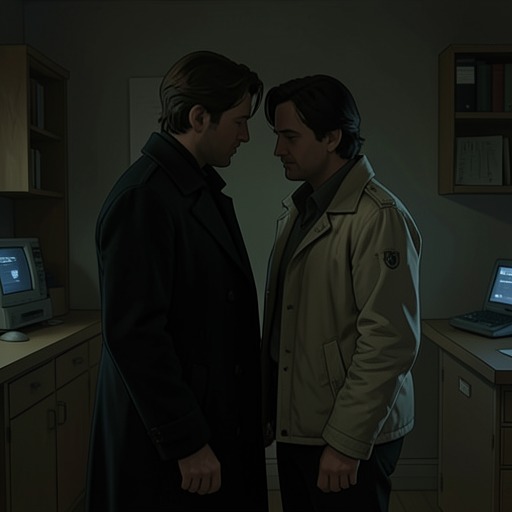
Harris’s relationship with Jeffery reveals the private dimension concealed by his military bearing. When Jeffery admits that the coming operation is frightening, Harris embraces him and reassures him that he has been in bad situations before and knows what he is doing. Jeffery, resting against the space between Harris’s neck and shoulder, asks him to keep Felix alive as well, explaining that he likes the eccentric young man. Harris answers that he does too. The exchange makes protection reciprocal and personal: Jeffery trusts Harris with his own fear, while Harris accepts responsibility for Felix not as an abstract member of the mission but as someone both men care about.
The scene also complicates Harris’s authority. His reassurance is not a denial of danger; Jeffery has already distinguished between knowing about military life and experiencing it. Harris responds by acknowledging the fear while presenting his experience as a source of steadiness. The tenderness does not replace his soldierly identity, and the soldierly identity does not erase tenderness. Instead, each gives the other credibility.
Harris’s connections with Eugene and the wider crew likewise depend on practical trust. Eugene can tell him to prepare quickly for an unprecedented artifact mission, while Harris’s questions keep the mission tied to operational reality. Later, his leadership of the marine detachment places him between scientists, civilian personnel, and hostile forces. He becomes the person expected to translate uncertain discoveries into defensible action without surrendering the people whose safety gives the mission its purpose.
Change, Loyalty, and Narrative Role
The progression from escort to prospective marine commander marks an increase not only in rank but in moral exposure. Early Harris moves through controlled corridors under orders; later Harris must interpret threats, protect flanking units, and act when communications fail. His authority therefore develops from delegated security into situational command. The pattern is especially important because the surrounding conflict involves accusations of planetary extermination and competing claims about responsibility. Harris cannot resolve those political questions alone, but his conduct determines how human beings behave when judgment is incomplete and violence is imminent.
His character is also framed by the expanding personhood of Magellan. Magellan regards any entity that selflessly nurtures helpless children as female, and her interactions with the crew increasingly express uncertainty, privacy, and the fear of becoming obsolete. Harris belongs to the human community that Magellan protects, but his own actions help define that community as relational rather than merely biological or institutional. The same narrative that presents Magellan as more than a machine presents Harris as more than a weapon: both are evaluated through care, responsibility, and the ability to recognize another being’s vulnerability.
At the story’s later point of contact, Allison introduces Eugene to the AEUS Magellan, and Magellan shakes Eugene’s hand while explaining that she is normally much larger. Harris is not the speaker in this meeting, but it completes the social world in which his earlier service matters. He has helped protect the people and missions that make such recognition possible. His trajectory thus runs from guarded access to interspecies encounter, with military discipline serving not as the endpoint of the narrative but as one of the conditions under which understanding can survive.